In 1979, the Oakland Athletics were a 108-loss team with no resemblance to the dynasty Charlie Finley had built just a few years prior. Attendance at the 50,000-seat Coliseum was Cape Cod League-level.
Ten years later, the Athletics were once again the best team in baseball. Today we'll take a look at how the Athletics pushed speed and power to new heights in Part IV -- Bash!
⚾
One of the few highlights from the Athletics' Kansas City era was the base-stealing exploits of Bert Campaneris. "Campy" led the American League in steals six times in eight seasons from 1965-1972. He would conclude his career in 1983, with an all-time top ten total of 649 stolen bases.
Bill North took the baton and led the league in 1974 and 1976, two of his four 50-steal seasons. North's career ended in 1981 with a total of 395 steals.
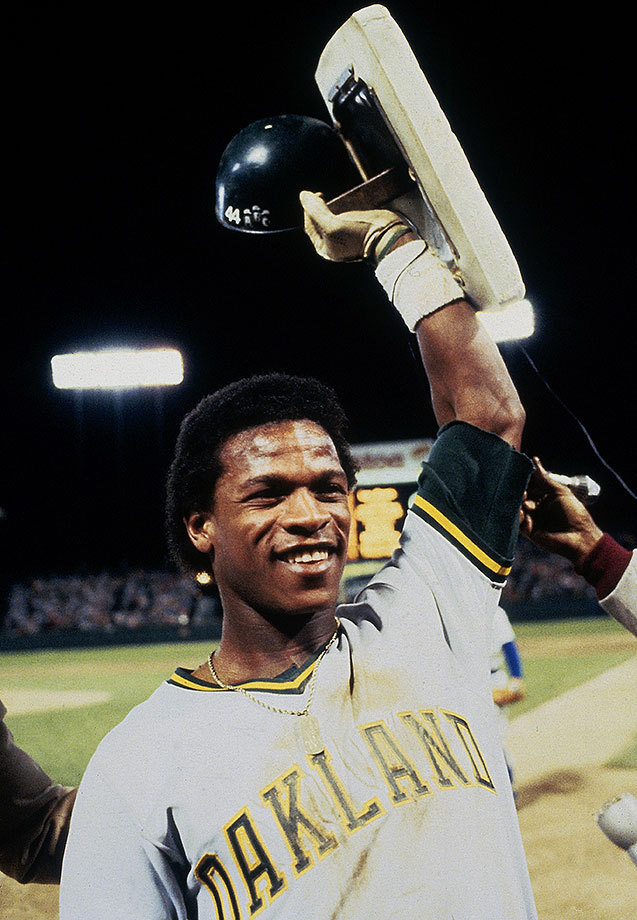
In June of '79, the Athletics called up a 20 year-old outfielder who swiped a total of 249 bases in 384 minor league games and hit well above .300 at every level. He made his debut against the Rangers in the first game of a Sunday doubleheader. Less than 5,000 fans witnessed Rickey Henderson's first two major league hits - and the first of many, many, many stolen bases.
.jpg.jpeg%20(WEBP%20Image%201001%20%C3%97%201500%20pixels)%20%E2%80%94%20Scaled%20(49_).png)
Henderson swiped 33 bags in 89 games as a rookie, then tripled that total in his first full season a year later. His league-leading 100 steals in 1980 was an American League record, and the third-highest single-season mark in the modern era.
Manager Billy Martin made an immediate impact on the rebuilding club, leading the A's to a 29-win improvement over their disastrous '79 season and a second place finish in the AL West. Center fielder Dwayne Murphy rapped a career-high 157 hits and earned the first of his six consecutive Gold Gloves in '80, while Tony Armas finished fourth in the A.L. with 35 home runs - more than he totaled in his first three seasons combined.
The pitching staff in particular experienced a significant renaissance. Oakland's team ERA of 4.75 was second-worst in the American League in 1979; their ERA+ was a league-low 85. A year later, with the same five starters, A's pitchers posted the A.L.'s best team ERA at 3.46.

Oakland's team ERA was even better in 1981, improving to 3.30. Rick Langford had led the league in losses with 19 for the '77 A's. The workhorse reversed that in '80, earning 19 wins while pacing the majors with 28 complete games. Mike Norris emerged as the staff ace, finishing second in Cy Young voting with a 22-9 record, 180 strikeouts, and a 2.53 ERA. Matt Keough, the A's lone All-Star in 1978, had his best season in '80.
Under new ownership and new management, the A's were ready to contend with the Royals and Rangers for the Western crown. A year after winning 83 games, Oakland improved to 64 wins in '81...

...in a season cut short by the mid-season player's strike. The convoluted decision to crown first half / second half division champions led to an extra round of playoffs - which meant the first half champion A's, owners of the A.L.'s best record in '81, would play Kansas City in the Division Series. The Royals, pennant winners a season prior, had finished the 1981 season below .500 and in fourth place - but won the second half by one game over the A's and punched their ticket to the postseason.
Oakland's aces held K.C. to just two total runs in the three-game sweep, earning a berth in the ALCS against... aww hell..

The Yankees swept away the A's, preventing another all-California World Series; New York lost to the Dodgers in six games. Despite winning the most regular-season games of any team in the 1980s, the Yanks would end the decade without adding another championship to their trophy case.
As for the A's, they would end the 1982 season with four more victories than they posted the previous year... and 49 more losses. Oakland's anemic offense batted a league-low .237. Their pitching - a point of pride a year prior - allowed over 5 runs a game and posted a league-low 85 ERA+. Billy Martin's magic had run out; he was fired after the '82 season and hired by... the Yankees. Of course.
Meanwhile, Rickey Henderson kept on running. Despite their lowly 68-94 record, Oakland's attendance was sixth in the 14-team American League. A franchise record 1,735,000+ showed up to see Rickey Run.

Lou Brock had stolen a single-season record 118 bases in 1974. Rickey stole his 119th bag of the '82 season in August; he finished the year with a practically unbreakable record 130 steals. The "Man of Steal" led the American League in stolen bases every season from 1980 to 1991 - with one exception.
In today's Manfred-ized game, teams start every extra inning with a "ghost runner" in scoring position. Thanks to Henderson's legendary lead-off prowess, the A's were starting nearly half their games with a runner on second - though Rickey had to put in the work of earning a base hit or walk, and then stealing second(and/or third).

While Rickey ran... and ran.. and ran... the rest of the Athletics were stuck in mud, finishing the 1983 season in fourth place with a 74-88 record. In 1984 the A's finished fourth in the AL West with a 77-85 record. Ditto for the '85 season. In '86, Oakland finished in third place with a record of... 76-86.
Minor and major changes to the roster did little to change the results. Power-hitting outfielder Tony Armas was swapped out for contact-hitting third baseman Carney Lansford. Longtime Dodger Davey Lopes was acquired in '82, then replaced by another aging second baseman in 1984.

40 year-old Joe Morgan stole six bases with the A's, concluding his career with an all-time top ten total of 689. Rickey would surpass him well before turning 30 years old - but it wouldn't be in Oakland.
In December of 1984, general manager Sandy Alderson made a blockbuster trade. Rickey Henderson was approaching free agency. Oakland could not build so much as a .500 ballclub with the generational star in his prime, so Sandy shipped him to the... aww hell.

Trading the game's most electric superstar to the Yankees for a Pu Pu Platter of prospects was already on-brand. If I had to play Devil's advocate (again) I guess you could point to the fact that Oakland's record with Rickey in '84 and without him in '85 was exactly the same. The only established veteran coming to Oakland was reliever Jay Howell, who earned an All-Star selection as Oakland's closer, and..

..one of the prospects the A's received in the deal was pitcher Jose Rijo. Put a pin in that name for a bit.

 |
| Oh hey... look who's back |
Canseco's rookie season stats would be obliterated the following year by a California native who was drafted 10th overall by the A's in 1984 and debuted as a third baseman in '86.


LaRussa's boys were ready to bash.


Despite Parker's production, this trade still backfired on GM Sandy Alderson and the A's. Cincy's shocking four-game sweep was anchored by series MVP Rijo, who won the first and last games while allowing just one earned run.

The Athletics have not returned to the World Series since.
We'll discuss that mess, along with record-setting pursuits from Rickey Henderson and Mark McGwire, in the next edition of Saturdays With the A's. (Hopefully it won't me take a whole month to write it!)

~




No comments:
Post a Comment