Tuesday, April 8, 2025

One Page PC - James Wilder

While digging through my football card box for Neil Lomax cards I came across a few singles of another underrated '80s NFL star that didn't get much national press because he played on a lousy team.


Drafted by Tampa one pick after St. Louis selected Lomax in 1981, James Wilder played ten NFL seasons - nine with the hapless Buccaneers, who only reached the playoffs twice in his tenure. Tampa parted ways with starting quarterback Doug Williams after the '82 campaign... and finished 2-14 in three of the next four seasons. 

Wilder did everything in his power to keep the Bucs competitive, leading the team in yards from scrimmage each year from 1982 to 1987. In 1984,  he led the NFL with a then-record 407 carries and set a single-season franchise record with 1,544 rushing yards -- still the highest total in Tampa Bay annals. Wilder also holds the Bucs' career records for carries (1,575) and rushing yards (5,957) 


While his average yards per carry (3.8) is sub-standard, he was an exceptional receiver out of the backfield. Among 1980s running backs, only Roger Craig and Marcus Allen had more receiving yards. 


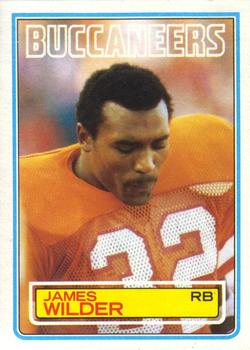
Here's my nine pocket PC of James Wilder. The 1983 Topps and 1985 Topps Wilder cards are about as exciting as his '87 and '88 issues, which is probably why I skipped them. The man's name is Wilder. Show him in action, dammit! 

That's better. 


As a kid I was drawn to the Bucs' orange creamsicle uniform, and it became apparent from Topps team Leader cards that the only player worth following (or collecting) from that era was their running back. 


According to TCDB, James has 71 cards - four fewer than Lomax. Look closer and you'll see that some of those listings are actually Leaf All-American cards of his son, James Wilder Jr. - who won a national championship at Florida State and has over 440 cards despite never playing in the NFL. 

Oh Canada...our home and native land...


I'd be willing to bet that every other NFL franchise's career rushing leader has more cards to collect than Wilder. Go ahead, name one. 

Ottis Anderson? 627
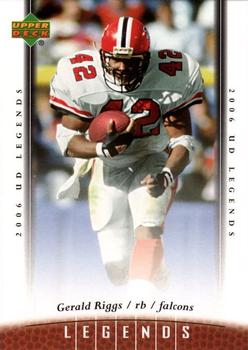
Gerald Riggs? 142
Sam Cunningham? All right, you got me. 29


Looking at the list of franchise leaders, it does make some sense that Wilder has the second-lowest amount of cards since his yardage total is the second-lowest. His career barely extended to 1990, and he was only in two traded sets so the overproduction era couldn't boost his card count like it did with Riggs and Anderson. But how does he have only half as many cards as Gerald Riggs? Why wasn't Wilder in Upper Deck Legends or named a Franchise Legend by Panini Prizm? 


Here's a better question -- why haven't the Tampa Bay Buccaneers added their all-time leading rusher to their Ring of Honor? They have a running back and an offensive star from the early-mid 1980s. Guess the Bucs thought that Mike Alstott and Jimmie Giles have got those bases covered. (btw, did you know Giles was drafted by the Los Angeles Dodgers in 1976? I didn't.) 


I'd love to end this post by showing off a James Wilder Starting Lineup figure, but 1988 Buccaneers are expensive! (This guy is dreaming; you can buy an autographed creamsicle jersey for that price.) 


Perhaps I'll pick up this SLU card someday. It's a sharper looking single than his Topps issues, but fifty times more expensive. 


🏈


I don't have any other mini-collections of overlooked football stars. The only other non-Hall of Famer who played before the 1990s and appears in my collection more than a few times is Steve Bartkowski, and he retired when I was in kindergarten. (Bart has 216 cards, btw.) 


Do you have any favorite "overlooked" football stars of your childhood?


Thanks for reading!


~

Sunday, April 6, 2025

One Page PC - Neil Lomax

I started collecting football cards in 1988, before I'd even seen a game on TV. Much of what I learned about out-of-market teams in the NFL (and the NBA and NHL) came from collecting cards. There may have been other ways to learn about underrated stars at the time, but if I didn't see them on SportsCenter or read about them in a magazine I only knew what the back of a trading card would tell me. 


One of those overlooked players was Neil Lomax, quarterback of the St. Louis/Phoenix Cardinals through much of the 1980s. The Cardinals were one of a few teams (along with the Buccaneers, Chargers, Seahawks, and Packers) that fascinated me as a kid because I only knew of their existence though Topps cards. I didn't see them on TV or hear about them, and I couldn't get my hands on their Starting Lineup figures (more on that later.)

Spending hours flipping over cards was my version of sports-reference pages. That was how I learned that Lomax was a really good passer and wondered why I didn't hear about him as much as Boomer Esiason or John Elway. Small markets were much smaller back then, and the Cardinals had just relocated from St. Louis. 

Also, as I would learn later on, playoff success is crucial. Esiason and Elway were AFC stalwarts, along with Dan Marino and Bernie Kosar. Joe Montana was king of the NFC (and NFL); Phil Simms and Randall Cunningham were leading nearby teams to the playoffs. Jim Everett and the L.A. Rams were emerging as a threat to the 49ers' dominance. 

I wanted to learn more about Lomax, but the Cardinals were terrible. And just when I started watching more SportsCenter and NFL highlight shows that covered the whole league... he was gone. I don't even think I noticed at first. Hey, a Cardinals highlight! Wait... who the heck is Timm Rosenbach??!?

A hip injury ended Lomax's career after the 1988 season, which is one reason why he's largely forgotten by modern NFL fans. The lack of playoff success and the fact that his team relocated are probably factors as well. Based on his too-brief career as a top tier passer, I initially though that Lomax was the Andrew Luck of the '80s... but his career numbers are more comparable to Baker Mayfield.


I had to laugh when I saw cards of his predecessor Jim Hart in 2024 Panini Prizm. No one is happy pulling Hart, but I would have liked a new Lomax card or two. He didn't have many cards during his career and has appeared in very few sets post-retirement.

This is a nearly complete career run of Lomax cards - I'm only missing 1984 Topps. Not pictured are two Team Leader cards from 1985 and 1987 Topps. According to TCDB, Lomax has 75 different cards - but they stretch the definition of "different" to include copyright variations and stickers with seven different backs. 

Only seven of those 75 cards were released post playing days, and two of those are 1989 Score buybacks. Lomax only has two autographed cards and no game-used issues, so a (more) complete PC wouldn't be expensive to build. 

I'm probably going to add his '84 Topps card to my next Sportlots order and I'm tempted to toss this in the cart as well: 


Or maybe I'll pick up a sealed figure and card on eBay to pair with my 1988 SLU:


Thanks for reading!


~


Saturday, March 22, 2025

Top players missing from 1956 Topps

1956 was Topps' first year as a baseball card monopoly. As a result, every notable major leaguer active during the 1955 season appeared in the 1956 set. 

Well... almost all of them. 


Stan Musial's glaring omission from most 1950s Topps sets is well-documented. 

Hall of Famer Ralph Kiner played 113 games for Cleveland during the 1955 season. The seven-time home run leader appears in 1951 and 1953 Topps - but not '54, '55, or '56. 


Like Stan Musial, Kiner appeared in Bowman sets from 1948 to 1955. Bowman threw in the towel after the 1955 season -- and Kiner did, too. He didn't appear in 1956 Topps because he retired in the off-season. 


Former Yankees pitchers Ed Lopat, Vic Raschi, and Spec Shea all retired after the 1955 season. None of them ended their careers in pinstripes.
 

Fifty-five was also five-time all-star Ferris Fain's farewell campaign. The two-time batting champion was released by the Tigers in July of 1955 and claimed by Cleveland a week later. 

Some notable players who didn't retire in 1955 and didn't appear in the 1956 Topps set include:


Another Bowman-only star, Sal Maglie appears in every Bowman set from 1951-55 and every Topps set from 1957-1960. Splitting time between the Giants and Indians in '55, Sal "The Barber" pitched 155 innings and posted a 9-7 record with a 3.77 ERA. He concluded his career with the Cardinals in 1958; Topps gave him a career-capper card in the 1959 series. 
 

Saul Rogovin appeared in both 1952 sets after leading the American League with a 2.78 ERA. He was a Bowman-only player in '53 and '54. After struggling with command he pitched the entire 1954 season in triple-A and was excluded from the 1955 sets as a result. However he bounced back that season after the Phillies claimed him in July. Topps included him in the 1957 set, which would be his final season. 

Aside from Musial and Maglie, Rogovin is the only player who remained active in the major leagues for 1956 and has a legitimate case for inclusion in that year's set. His 3.08 ERA was the lowest of any Phillies starter in 1955, he pitched more innings (and earned a higher WAR) than Ron Negray - who appears in the set. 21-year-old rookie Jim Owens also has a card at Saul's expense - despite a career stat line of just two starts and a third appearance in relief at the conclusion of 1955.
 

Other players who could have been included in the '56 Topps set but who probably weren't missed:

Leo Kiely boasted the lowest ERA of any Red Sox pitcher in '55 and logged more innings than Tom Hurd, Ellis Kinder, and Dick Brodowski - all of whom could be pulled from packs of 1956 Topps. 

Harry Byrd had a mediocre 1955 season split between the Orioles and White Sox. Topps could be forgiven for excluding a starting pitcher with a 7-8 record and 4.61 ERA over 156 innings, though there were plenty of pack-pulled pitchers who had far worse stat lines that season. And none of them were named AL Rookie of the Year two years prior. 


Cincinnati Redlegs rookie Rudy Minarcin "earned" a spot in the '56 set with a 4.90 ERA and 45 strikeouts against 51 walks, while veteran Jackie Collum missed the cut. Cincy's #4 starter struck out more batters than he walked, posted a winning record as a starter, and had a respectable 3.63 ERA. He also logged more innings than four other Redlegs hurlers who appeared in the '56 set.  

Topps didn't miss out on many position players who were worthy of a card (and continued playing) in '56. The best one I could find was Cal Abrams - who started more games than all but four hitters in the light-hitting lineup of the '55 Baltimore Orioles. 

Finishing sixth on the O's with 75 hits (and first with a 1.8 WAR, for what that's worth) Abrams was skipped by Topps in favor of reserve outfielder Jim Dyck and light-hitting infielder Fred Marsh.
 

Musial aside, the list of players who didn't get a Topps card in 1956 would probably be comparable to any list of snubbed players throughout the past 70 years. Long before rookie cards were the heartbeat of the hobby, Topps (and Bowman) gambled on prospects and call-ups over run-of-the-mill reserves. 

Such foresight led to the inclusion of Roberto Clemente and Sandy Koufax in the 1955 set and Luis Aparicio in '56. The White Sox great had not made his major league debut in the previous season.. but a Hall of Fame hurler did. And Topps missed him. 


Here are the 1955 stat lines of five rookie pitchers. Three were included in the 1956 set, two were not:

inningsW-LK'sBBERA
pitcher A18 1/30-01155.40
pitcher B8 2/30-2678.31
pitcher C123 2/34-768715.31
pitcher D70-131714.14
pitcher E513-537326.35


Pitcher A is Don Kaiser


Pitcher B is Jim Owens


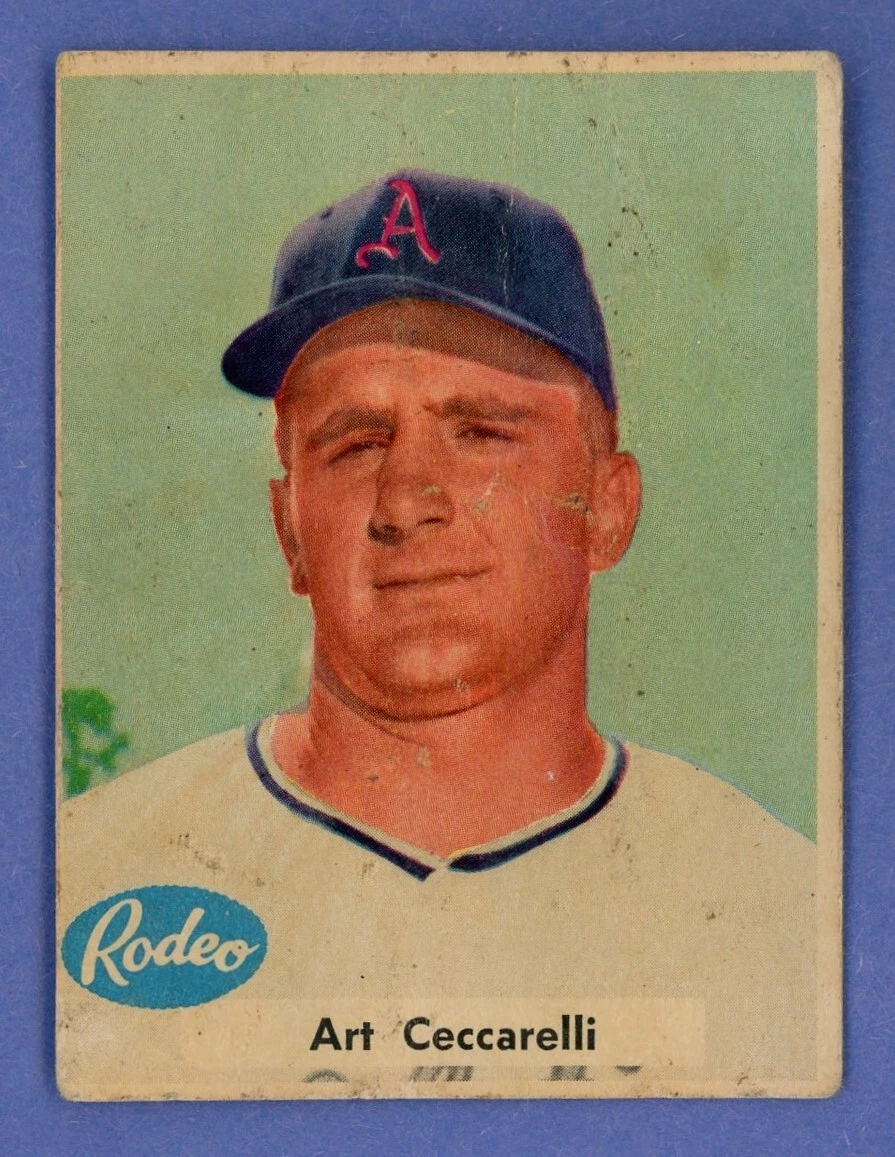
Pitcher C is my homie Art Ceccarelli - who logged a lot of innings for the A's but pitched poorly. 

This card is so frickin expensive!!


Pitcher D is Paul Martin


...who never pitched in the majors again after his disastrous seven-inning audition in 1955. 


Pitcher E, who struck out more batters than he walked and totaled more innings, wins, and whiffs than the three rookie hurlers who appeared in the set... is Jim Bunning:


The collector in me is relieved that I won't have to spend triple digits on his rookie card. The historian in me feels a bit disappointed that a complete set of 1956 Topps baseball cards does not tell a complete story of baseball at the time. Perhaps this post can serve as an addendum....


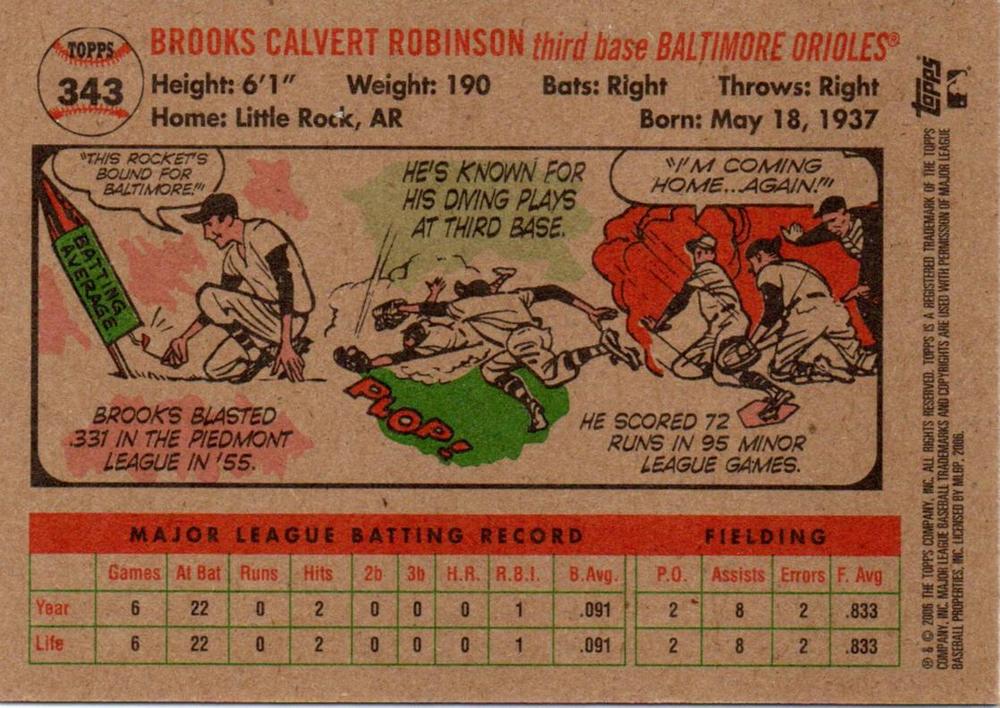
1956 Topps Traded & Rookies: cards #341-350

341 - Stan Musial - Cardinals
342 - Sal Maglie - Indians
343 - Brooks Robinson - Orioles
344 - Saul Rogovin - Phillies
345 - Cal Abrams - Orioles
346 - Art Ceccarelli - Athletics
347 - Leo Kiely - Red Sox
348 - Jackie Collum - Redlegs
349 -  Jim Bunning - Tigers
350 - Harry Byrd - White Sox


Thanks for reading!


~

Thursday, March 20, 2025

Shoresy

 Yeahso... I binge watched all four seasons of Shoresy last weekend. Might watch it again this weekend. 


Lotsa chirpin', lotsa cursin' and carryin' on. But there's a good story in it, too. The show is a spinoff of another Canadian cult classic, Letterkenny - in which Shoresy was a background character. Both shows were created by Jared Keeso - who also leads both (in Letterkenny as Wayne and in the titular role of Shoresy) Keeso is joined by former pro hockey players Jonathan Diaby (Dolo), Jon Mirasty, Brandon Nolan and Jordan Nolan (the Jims), and Terry Ryan as Ted Hitchcock. (If you say it real fast, it sounds like...)


I'd most likely be a fan of any scripted series centered around hockey but this one really exceeded my expectations and hit the spot after the recent Four Nations tournament. It's a very Canadian show and it's a love letter to hockey, so if you're not familiar with either it might not be as enjoyable. But there's still a lot to like even for the most casual sports fan. I've seen it pop up a lot on TV reviewer sites, which is awesome because this show deserves a wider audience regardless of the endless chirps and "your mom" jokes. 

The diversity of this show stands out to me, particularly at a time when the Musk administration has tried to purge Black heroes like Jackie Robinson and the Tuskegee Airmen from the history books.

[ To be fair  "to be faiiir" "to be faiiiirrrr" "to be fairrrrrrr" Letterkenny has also stood up against racism and fascism - particularly in an episode that echoed the Nazi rally in Charlottesville, VA. ]


Shoresy's team, the Sudbury Blueberry Bulldogs, are owned and operated by women. The front office,  head coach and three players (the Jims) are all natives ("tough natives" is redundant). Shoresy is tough as nails and a relentless chirper, but he's not afraid to cry in public. His foster family is mixed race and includes a lesbian couple, and even when he goes on a rant about locker room behavior that starts to lean right-wing.. he brings it back by citing a story of how showering with teammates led one player to discover he was gay.  


Dolo's background includes an actual incident involving a racist fan Diaby confronted in Quebec:


The women of Sudbury call the players "sluts" because the boys do all the sleepin' around -- especially the biggest bear on the Bulldogs, Jean-Jacques Francois Jacques-Jean (or JJ Frankie JJ for short). JJ screws around with three different women including actress Laurence Leboeuf, who plays herself (and has caused me to randomly say Laurence Leboeuf in a French accent for no apparent reason.) 


The Jims even find themselves in kangaroo court after snitching on the boys' extra-curriculars.  However, the one guy who won't screw around with young models or pop stars.. is Shoresy. 

Our protagonist fancies older women - which won't get filed under Woke DEI Wokeness or whatever, but is against the grain for athletes and fictional shows. The relationship between Shoresy and local journalist / single mom Laura Mohr is perhaps the most endearing part of the show. Even though I'm partial to Ted's waitress girlfriend Pam I'm more invested in the Laura storyline. 


I've got some seasons of Letterkenny to catch up on while I wait for season 5 of Shoresy - but I think the spinoff might be the better show.


Thanks for reading!


~

Thursday, January 16, 2025

A HOFer without a RC?!?

 Let's say you collect rookie cards of baseball hall of famers. 

You were expecting Adrian Beltre to be a first-ballot inductee so you planned ahead and picked up his 1997 Bowman (or Chrome) rookie card. 

Todd Helton was nearly elected in 2023, so you prepared by picking up his 1993 Topps Traded RC. 

Perhaps Joe Mauer's first-ballot election caught you by surprise. Not to worry; his Bowman, Bowman Heritage, and Topps rookie cards should only set you back a few bucks. There's also Topps Chrome and Pristine if you're shopping for luxury.

You look ahead to the 2025 baseball hall of fame ballot. There's Ichiro, and his dozens of rookie cards.

Carsten Charles has four from 1999 Topps products: Bowman, Bowman Chrome, Bowman's Best, and Finest. Two more late-season sets added Sabathia: Topps Traded and Topps Chrome Traded.  

Billy Wagner should get in, and he's got a handful of affordable RCs in 1994 sets.

Andruw Jones is a long shot, but you pick up his 1995 Bowman and/or Bowman's Best RCs just in case. 

And then there's Carlos Beltran. He was a few votes behind Jones on the 2024 ballot, but perhaps the BBWAA voters are through punishing him for banging those trash cans in Houston. If he doesn't get in this year, he'll likely headline the very thin class of 2026. You'll probably want to pick up his rookie card soon.

Not it.

This is a rare example of a Bowman first card not being a player's first card. Go back two years. 


Not it.

Technically this is Beltran's first card - but since it's a minor league prospect set it's not an official RC.

Topps whiffed on adding him to the 1995 Bowman set but they didn't forget him entirely. He's got one rookie card in the Traded set, and it's ... wait a sec...

Not it.

That's... not Carlos Beltran. It says Carlos Beltran right along the bottom there, but that ain't him.

Topps messed up. Big time. 


If you insist on purchasing a rookie card with Beltran pictured, you'll have to buy a LeBron:


It's practically unheard of in the modern era for a star player -- a surefire Hall of Fame player -- to have just one single rookie card. Carlos Beltran doesn't even have that; this is a Juan LeBron card.


If you're hoarding Hall of Famer RCs, which one do you buy? Both? Neither? 


There is... one more option. Beltran was somehow left out of 1995 Bowman but he technically appears in 1995 Bowman's Best. 


......


Not this Juan, either.


Thanks for reading!


~

Celebration Preparation

 Most of the Anniversary gift packages should be arriving tomorrow so I wanted to post this before you open them up...  These numbered packs...